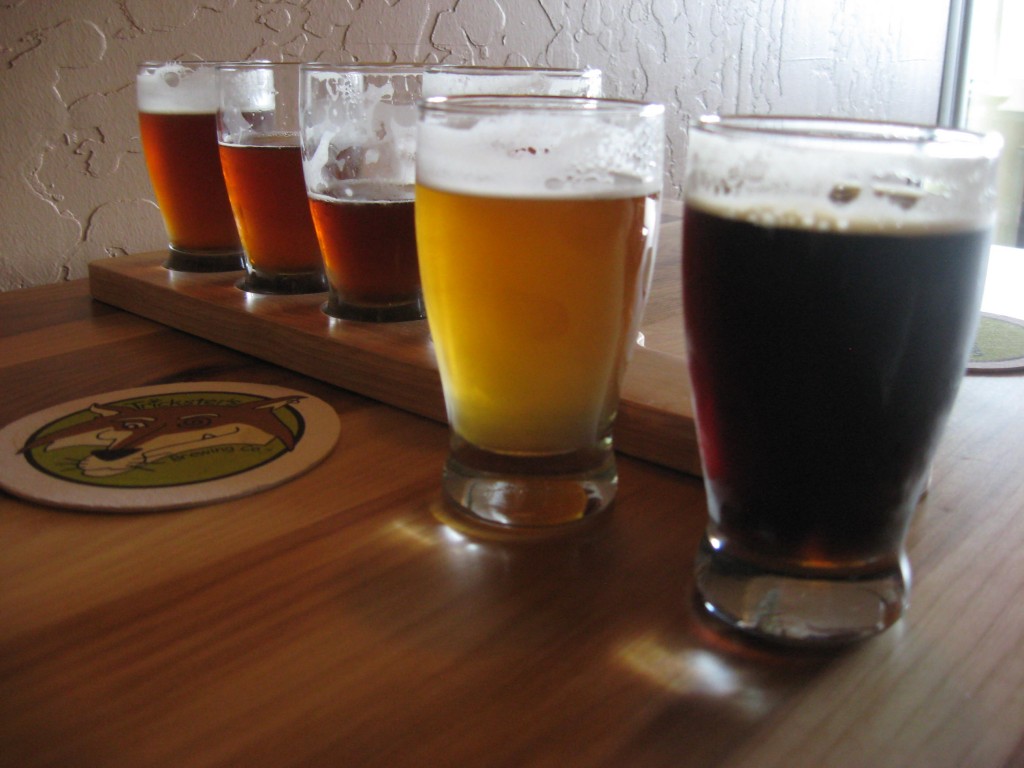
The Blackberry Farm Brewery: A Tennessee Miracle

For a far too brief a time, back in 1989 – 1991, I lived in Knoxville, Tennessee. I absolutely loved it there. Some of the best memories I own are of sitting on my back stoop in the evening, after a long day of pulling kudzu and reframing windows and doors, and looking out that long vista across downtown and out to Fountain City and Powell while sipping iced Red Zinger tea. A family I love very much lived right across the street and I was involved in starting a new regional theater company, from absolute scratch. It was a magical time…spoiled slightly by one major deficiency…
No beer. At least, no beer that a hard-core, life-long beer snob such as me would even think about drinking.
Want to read more? Please click…
HERE
A Big Merger May Flatten America’s Beer Market

ANHEUSER BUSCH-INBEV, the world’s largest brewer, recently made headlines by announcing that it would temporarily rename Budweiser, one of its best-selling beers, as America. It’s a curious name choice, not only because AB-InBev is based in Belgium, but also because of what the new name stands for: independence.
As Anheuser-Busch InBev looks to finalize a $107 billion merger with SABMiller, the world’s second-largest brewer, federal antitrust authorities need to weigh what this means for the growing number of small brewers and independent distributors who are driving the industry. Recent reports say that antitrust authorities are likely to approve the deal by the end of the month. If they do so without adequate protections, the merger could stifle consumer choice and choke off America’s beer renaissance.
Want to read more? Please click…
MORE
Women in Beer: A Portraiture Series
Unfortunately a lot of uncovered women brewers here-PGA

The craft beer industry, a notoriously male-dominated sphere, is experiencing a major shift in demographics. Not only are more women enjoying beer, but increasingly they are becoming the brewers themselves.
After reading an article about Local Brewing Co., a brewery owned and operated by two women, San Francisco photographer Natalie Jenks was inspired to create a portraiture series celebrating women in beer. She began this journey in July 2015, becoming increasingly impressed with the various jobs that females were holding in the industry. From her subjects, she quickly discovered that women were occupying positions across the craft beer industry spectrum, fulfilling roles such as brewery owner, brewer, lab manager, beer delivery and marketing coordinator, among others.
In creating these portraits, Jenks desired to emphasize the role of each individual female within the context of her workplace. Interestingly, she learned from her subjects that, unlike many other largely male fields, the craft beer industry is truly one of collaboration, not competition. Women in beer are quickly becoming less of an anomaly, and as Jenks states on her website, “The hope is that we get to a place where it’s not about being a woman, it’s just about making great beer.â€
Want to read more? Please click…
HERE
The Fool’s Semi-Annual, Self Destructive Throw-Down on Self-Reliance
This post was motivated by a recent and frenzied convergence of dozens of people with whom I have an online relationship, writing things that are rooted deeply in some antiquated notion that there are Universal Absolutes that apply to all evaluation of their beers, wines, or booze faves. I participated in a discussion, last week, in which a notable and respected beer writer opined that he was put off by all these different kinds of beers; all the stylistic variations and what he considers wrong-headed misinterpretations of styles. He took specific aim at the Black IPA, otherwise known as the CDA – Cascadian Dark Ale. He never mentioned the CDA but claimed that calling something “Black†as attached to a style of ale properly called “India PALE Ale†makes no sense. And, in one sense, he’s right. Maybe some name like “India Dark Ale† would fix his problem but somehow I suspect it wouldn’t. Most people who waste valuable air, blood, and minutes bitching about well established things they have zero hope of influencing wouldn’t consider the problem fixed unless they could summarily waive it totally out of existence. I can’t speak for him, of course, but as the conversation centered on the idea that we don’t need all these different styles of beer, I feel safe in saying that he wishes the whole notion would just…go away.
Want to read more? Please click…
HERE
An Introduction to Cask Conditioning Homebrew

Who says you can’t have your own “Firkin Friday†at your homebrewery? We took a look at what makes beer “real ale,†how to cask condition and serve your real ale and a heated debate that surrounds the real ale campaign.
What is Real Ale?
By definition, “real ale†is a name for draught (or bottled) beer brewed from traditional ingredients, matured by secondary fermentation in the container from which it is dispensed, and served without the use of extraneous carbon dioxide. To the homebrewer, this may sound like any bottle conditioned beer is technically real ale, but the British-based group Campaign for Real Ale (CAMRA) uses the term to specifically refer to traditional British beer styles (bitters, stouts, pale ales, etc.) that were served at cellar temperatures (52-57° F) and a specific low level of carbonation (<1 vol. of CO2).
The push for authentic real ale is much less of a matter in the United States compared to Great Britain, but the interest in serving cask-conditioned beer is becoming more and more prevalent at state-side watering holes and among homebrewers.
Want to read more? Please click…
HERE
Maria Devan Reviews Genessee Brewhouse IPA
Archaeologists Discovered a 5,000-Year-Old Beer Recipe in China

Step aside with your claims to long legacies, craft breweries! This reconstructed beer recipe is over 5,000 years old. It’s the earliest beer recipe—and the earliest known use of barley—in China.
Archaeologists at Stanford University, wile digging along China’s Wei River, made an intriguing discovery: A marvelously complete set of brewing equipment. And at the bottom of that equipment was something even more wonderful: Residue from the drink it once brew
Want to read more? Please click…
HERE
Maria Devan Reviews Keuka 607 Lager
A Beer Judge’s Diary: Jackalope’s Let’s Get WEIRD
Our Winners
1st – Keith Baker, Toledo, OH – Coffee Blonde
2nd – Brent Fagan, Jeff Bellamy, Nowell Robbins, Murfreesboro, TN – Hint-O-Mint Chocolate Milk Stout
3rd – Aaron McDonald, Nashville, TN – Pad ThaI.P.A.
Our Judges
Bailey Spaulding
Steve Wright
Kat Schermerhorn
Joe Kane
Millie Carman
Will Hadley
George Talley
Ken Carman
Grant Ferris
Competition Organizer and Steward
Kristen Westerbeck
Judge Coordinator
Ken Carman

The members of Music City Brewers were contacted a few months ago by the fine folks at Jackalope Brewing here in Nashville about having our National Homebrew Day at their brewery. Here’s the problem: alcohol in the parking lot? Nicht. Music City Brewers putting up our tents on a slant; taking up their parking lot so many members can brew  on the premises? Non. Brewing inside wouldn’t have worked: we take up a lot of space and would have gotten in the way of production; especially on certain days when they package. We would have been in the way so much someone might have gotten…canned. On his busy way to brew Steve might have stumbled into a mash tun. Bailey might have been baffled when she felt even more roasty, toasty because so many pots were on boil.
Oh, and then there’s the fact we delight in bringing in all kinds of beer to sample and make hot scotchies. Perhaps a metro policeman named Scotty might have put the kibosh on that as his kilt tilted in the wind as a few of us wished someone had beamed HIM up. Continue reading “A Beer Judge’s Diary: Jackalope’s Let’s Get WEIRD”
You must be logged in to post a comment.