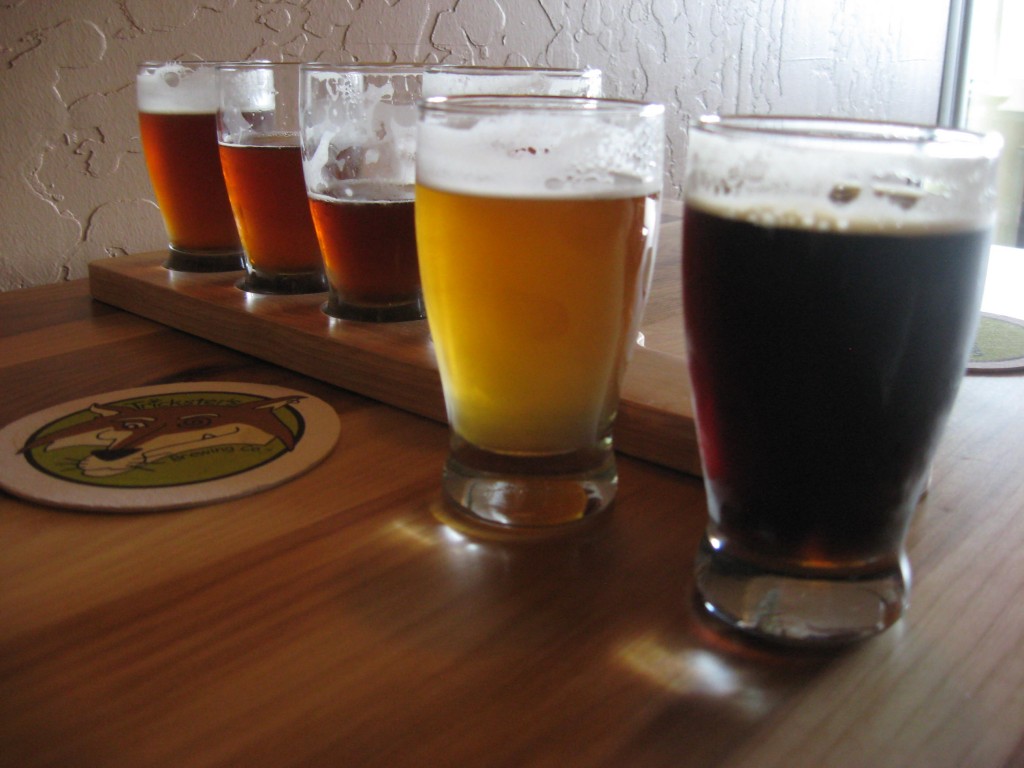
Florida Weisse: Our Own Style of Beer

Weisse Florida beer1
While the upper U.S. West coast has a beer style to call its own (Cascadian Dark Ale), it appears that the craft beer movement in Florida has spawned a new style of beer: the Florida Weisse.

The second annual Berliner Bash on the Bay in Gulfport, Florida, was recently held on April 20 and several Florida brewers took the opportunity to showcase what exactly the Florida Weisse is all about.

A regional sour wheat beer that originated in Northern Germany, the Berliner Weisse is not superpotent –ranging anywhere from two to five percent alcohol-by-volume. Like the Berliner Weisse, the Florida Weisse is low-alcohol too. A low-ABV beer may not sound attractive compared to 13 percent-plus imperial stouts, but remember that alcohol is only a small part of its character.

Whereas a heavy emphasis is placed on hops in West coast-style ales, the Florida Weisse is different. Based on the traditional German Berliner Weisse beer, the Florida Weisse is brewed with lots of fruit–particularly tropical fruit–rather than just simply having fruited syrup added to the glass when the beer is poured. The sweetness of the syrup is supposed to balance the acidity of the beer.

“That’s the traditional way of doing it,” said Johnathan Wakefield, Miami home-brewer and owner/founder of J. Wakefield Brewing Company. “But we’re not doing anything traditional.”

Want to read more? Please click…

HERE

Beer Profile: Good People Brewing’s Coffee Oatmeal Stout

Good People Brewing Company

Profiled by Ken Carman for professorgoodales.net

Beer-Profile1-258x300Pillow head: lots of. SRM low 30s, no visual through except some slight shimmering garnet highlights.

Nose: slight sour, as can be expected in some stouts, though less so in oatmeal. Slight coffee, hint of roasted barley.

Full mouthfeel as expected with oatmeal, with some almost espresso cling to the roof of the mouth. A hint of slick.

Taste: there’s a lot of coffee in this, dominant. As of late I’ve had a lot of coffee beers where the brewer went nuts with adding coffee. This isn’t one of those, just a bit too much. The roasted barley expected in a stout kind of gets lost with the espresso sense, but nice malt background and hint of oatmeal, but that gets lost for the most part… except in the mouthfeel. Some sour sense. Carbonation light in the body.

Overall a very good coffee stout, but could use just a little more malt and roasted barley sense. And just a slight back off on the coffee. I’d sell this as a slightly soured (not common in oatmeal stouts: more so in dry) coffee Porter. The stout part seems to be missing, as in roasted barley.

I do recommend it. If I could give it a 3.5 or more I would, but I can’t quite give it a 4…

3361242-simple-drawing-of-a-pint-of-beer-isolated-on-white3361242-simple-drawing-of-a-pint-of-beer-isolated-on-white3361242-simple-drawing-of-a-pint-of-beer-isolated-on-white

Welcome to the PGA beer rating system: one beer “Don’t bother.” Two: Eh, if someone gives it to you, drink. Three: very good, go ahead and seek it out, but be aware there is at least one problem. Four: seek it out. Five: pretty much “prefecto.”

On Tap: Larger Brewers Think Small to Keep Innovation Flowing

The R&D lab where Long Trail brewers perform their experiments is inside a drafty old farmhouse about a five-minute walk from the main brewery in Bridgewater.

It is an unpretentious little facility and the brewers like it that way.

“This is about as free form as it can get,” said Brandon Mayes, a Long Trail brewer. “Any ideas that the guys have, they should be free to pursue.”

The “pilot facility” was a small white room where four stainless steel kettles sat on burners, and bags of grain were stored nearby in the barn. Head brewer Dave Hartmann was standing inside with his colleague, Sam Clemens, who was hand-cranking a mill filled with malted barley.

On this particular Tuesday, Clemens and Hartmann were making two different batches of beer. One was a wheat IPA. The other was a black walnut dunkelweizen.

Want to read more? Please click…

HERE

15 Coolest Beer Taps

gun-beer-tap
We can’t help the fact that we’re sometimes attracted to bright, shiny objects. It’s why we do occasionally judge a book by its cover, and it’s also why we may order a beer we don’t know based on the really awesome tap handle associated with it. This doesn’t happen all the time, but we’re pretty sure it would be hard to pass up the suds coming from these guys.

Want to read more? Please click…

HERE

Two-Row vs. Six-Row Barley

barleyI was sitting in the shade enjoying the lovely Belgian ale on tap when someone asked me what I thought about two-row barley. I am lucky enough to live in a region where I can get either six-row or two-row most of the time, so I adjust my grain bill to the recipe at hand, rather than the other way around. Many brewers prefer two-row barley for its greater extract value; on examination that’s interesting, since the difference is 1 to 2 percent, hardly noticeable at the homebrewer level. I generally prefer two-row, but I’m not sure I could quantify why, since both types appear in many of my favorite beers. Maybe we all think two-row is just more chic.

Two-row or six-row? It’s a very American question. Most of the rest of the world uses six-row barley only for livestock feed, not for beer. I thought six-row barley had been bred especially to increase output, but it turns out to be a naturally-occurring result of a pair of mutations, one dominant and one recessive. Both two-row and six-row barley have been around for a long, long time.

Breeding efforts of the last half-century have reduced and perhaps functionally eliminated most of the differences between the two types of barley. Economies of scale at big breweries make many of their differences moot. There are still distinctions between kernel size, extract, protein and enzymes—all this information can be found online, depending on your tolerance for technical detail.

Want to read more? Please click…

HERE

Ohio Governor Signs Bill That Benefits Craft Brewers

beer-news10
Ohio Gov. John Kasich signed a controversial brewery bill Tuesday afternoon that benefits craft brewers and was blasted by Anheuser-Busch InBev.

The legislation creates a new liquor permit for breweries that make less than 31 million gallons a year. The new permit, called an A-1c, will replace the A-1 permit for small brewers and reduce their annual licensing fee from $3,906 to $1,000.

Craft brewers have praised the legislation, saying it will allow them to invest more money into their breweries.

Want to read more? Please click…

HERE

ohio

Your Hydrometer is Lying to You

hydrometer
Note: while this article if from a wine blog, certainly hombrewers can find useful information too.

One of the most useful pieces of kit that a winemaker can have is a hydrometer. Simple devices, they are closed cylindrical glass tube weighted with steel shot at one end (steel, not mercury or lead like some sources claim). Inside the tube is a piece of paper with a scale of numbers, usually running from 0.990 to 1.100, in increments of 0.002. Because the sealed tube is hollow, it floats in liquid. Because it is weighted, the heavy end points down, ensuring that the scale is upright and readable.To use it, you carefully place it into your wine (works on beer too) and read the scale where the liquid touches the tube.

Many people, when asked what a hydrometer does, will answer, ‘Measures alcohol’. Some will say, ‘Measures sugar’. Neither answer is true. Hydrometers compare the the ratio of the density of the liquid to the density of water, and that’s all. It’s what we can do with this reading that’s useful to us.

If we use a standard home winemaking hydrometer on our must before fermentation, the liquid will be very high in sugar, and thus will have a density higher than that of pure water. Depending on the wine type, it could by anywhere from 1.070 to 1.110 times as dense. After we pitch yeast and the fermentation is ongoing, the sugar will be metabolised into carbon dioxide and alcohol. As the sugar levels drop, the density of the must will go down and the hydrometer won’t float quite as high. This drop shows us the progress of fermentation–which is why it’s important to record the initial gravity reading, so you can compare it. More on this below.

Want to read more? Please click…

HERE

Beer Profile: Barrel Aged Hoppin Frog Christmas Ale #2

HoppinFrog-BAChristmasLabel2

Profiled by Ken Carman for professorgoodales.net

Beer-Profile1-258x300Nose: oak, a little sweet. Mouthfeel sweet with some oak clinging to the roof of the mouth. Bourbon in still in the mix, but lighter. A little bourbon cling, but not as dominant. In #1 barrel aged the spices were obvious, though background. In number two I think the oak, with the bourbon almost perfectly counter balanced, made the spices kind of disappear.

Once again brown with great highlights, clarity good and head lingers: pillow. SRM high 20s.

I did find spices in the nose, but slight and hard to perceive. Oak is stronger, bourbon behind that. Mouthfeel is just a little more bourbon focused: sweet coats the back of the mouth. Medium body, hint of caramelization, good clarity with brown/ruby highlights. Soured orange sense, which I’m sure is the bourbon, on the palate.

What happened here is balance is actually working against us. With the bourbon just a hint on top, but the rest firmly beneath, it was superb. With the bourbon and the oak mostly in balance the spices seem less important, the oak and bourbon arguing so loudly on the palate the spices almost might as well not be there.

A very pleasing quaff, but, honestly, I didn’t enjoy it as much as the first, though it’s still is very, very good.

I wasn’t tempted at all to give this a 5 out of 5, but it still deserves 4. Maybe even 4.5, though I do feel the balance is so even the flavors are battling for attention a bit too much.

3361242-simple-drawing-of-a-pint-of-beer-isolated-on-white3361242-simple-drawing-of-a-pint-of-beer-isolated-on-white3361242-simple-drawing-of-a-pint-of-beer-isolated-on-white3361242-simple-drawing-of-a-pint-of-beer-isolated-on-white

Welcome to the PGA beer rating system: one beer “Don’t bother.” Two: Eh, if someone gives it to you, drink. Three: very good, go ahead and seek it out, but be aware there is at least one problem. Four: seek it out. Five: pretty much “prefecto.”

Beer Profile: Hoppin Frog’s Barrel Aged Christmas Ale #1

HoppinFrog-BAChristmasLabel2

Profiled by Ken Carman for professorgoodales.net

Beer-Profile1-258x300Pop the cap, sniff and I immediately get oak. This year Hoppin’s Christmas comes in three types, the regular which I won’t open until Labor Day 2013 for my beer tastings in the Adirondacks. This seemed like it may be the barrel aged oak forward, as described by the folks at HF, until it warmed up and the bourbon came on strong. The nose is absolutely: spiced. Ginger, cinnamon and some nutmeg. The brown ale nose is way in the back.

Taste: the same. Bourbon pops out as it warms, more in the taste.

Mouthfeel is medium body with bourbon cling to the top of the palate. Low carbonation leaves just a hint of tingle.

Off white, pillow, head. Clarity very good with deep ruby highlights. SRM about 20-22. Nice perfect brown. The magic here is it is so multi-dimensional. The body is medium on the lighter side of, but bourbon and spices make it seem like more. Bourbon sweetness hangs after rest of the flavor fades.

Sipping on this is like savoring a fine light bourbon. The spices are way in the background but the bourbon first, the oak second, the sweet brown malt third and then the spices as a firm after thought. This is a perfect balance for what they were shooting for, and it definitely made me think “Christmas,” even in April. We’ll see next time how savory the oak forward Christmas Ale is.

I was tempted to give it a 5 out of 5. So I did.

3361242-simple-drawing-of-a-pint-of-beer-isolated-on-white3361242-simple-drawing-of-a-pint-of-beer-isolated-on-white3361242-simple-drawing-of-a-pint-of-beer-isolated-on-white3361242-simple-drawing-of-a-pint-of-beer-isolated-on-white3361242-simple-drawing-of-a-pint-of-beer-isolated-on-white

Welcome to the PGA beer rating system: one beer “Don’t bother.” Two: Eh, if someone gives it to you, drink. Three: very good, go ahead and seek it out, but be aware there is at least one problem. Four: seek it out. Five: pretty much “prefecto.”