This App Knows Your Taste in Beer

Picture courtesy zooqini.com

Written by David Ranii for newsobserver.com

Beer Prophet is an app for the iPhone and iPad that sells for 99 cents and was created by a quartet of Triangle entrepreneurs. What it does is recommend beers you’re likely to enjoy based on your past preferences. And you can continuously update your taste profile by making entries about your likes and dislikes in a personal beer journal as you give new brews a try.

“The more you use it, the better it becomes for you,” said John Federal, who has worked on Beer Prophet. Federal’s day job is manager of American Brewmaster, a Raleigh store that caters to people who make beer and wine at home.

Beer Prophet grew out of a conversation that Pete Pagano, owner of Tir Na Nog Irish pub in downtown Raleigh, had with a friend. They were discussing how to best serve customers seeking suggestions of what beers they would like based on the brews they already know they like.

Pagano and his buddy recruited two tech-savvy friends and formed Zooqini, the company behind Beer Prophet. Each of them is an equal partner in the business, but for now the others prefer not to be named, Pagano said.

Continue reading “This App Knows Your Taste in Beer”

South Vancouver Island a Haven for Craft Brewing

Owners and brewer Bonnie and Don Bradley inside the fermentation tank room at The Moon Under Water Brewpub in Victoria, BC. Picture credit: Chad Hipolito for The Globe and MailOwners and brewers Bonnie and Don Bradley inside the fermentation tank room at The Moon Under Water brewpub in Victoria,BC December 20, 2011. - Owners and brewers Bonnie and Don Bradley inside the fermentation tank room at The Moon Under Water brewpub in Victoria,BC December 20, 2011. | Chad Hipolito For The Globe And Mail

Written by Tom Hawthorn for theglobeandmail.com

A private liquor store in Oak Bay promotes the sale of locally brewed ales and lagers in what it calls the “two-mile beer diet.”

At long last, a diet I can follow.

Let’s go to the source. Drive along busy Bay Street to the Rock Bay industrial corridor. Stop at a commercial strip mall. Across the street is a gravel yard. In a nondescript cinderblock building, a former Direct Buy showroom has been transformed into a pub.

This is The Moon Under Water pub and brewery, which boasts “the best service in town – because you serve yourself.” Patrons order from the bar, where publicans pour from taps.
Continue reading “South Vancouver Island a Haven for Craft Brewing”

Beer News Flows Through the Holidays

Suds with a sack of sliders? White Castle is testing beer and wine sales at one of its stores in Indiana. (AP Photo/Jay LaPrete)

White Castle burger chain considers alcohol sales

The holidays are normally a slow time for news, which is why so many media outlets resort to year-end “listicles” to tide you over. Not so with beer news, apparently, which came at a furious pace this week. Here’s a recap of what you may have missed from around the country:

• A federal judge in Texas struck down a longtime Lone Star State statute that required breweries to label any beer containing more than 4 percent alcohol by weight “ale” (anything less could be called “beer”). As any beer geek will tell you, all ales are beers, but not all beers are ales (some are lagers). So it was silly that brewers of, say, a Vienna lager had to put “Ale in Texas” on the beer’s label. Not anymore. Calling the requirement a restriction on commercial speech, Judge Sam Sparks compared the antiquated law to “defining the word ‘milk’ to mean ‘a nocturnal flying mammal that eats insects and employs echolocation.’ ” Props to Judge Sparks for making me Google “echolocation,” and to Austin, Texas, craft brewery Jester King, which helped champion the litigation against the Texas Alcoholic Beverage Commission.

Continue reading “Beer News Flows Through the Holidays”

11 Craft Beer Companies That Went From Little To Big Time

Written by Eric Goldschein for businessinsider.com

Since the 1990s, the craft brewing movement has been slowly taking over the beer-making industry.

Yes, big beer makers are still king, and control more than 93 percent of overall beer sales in the country. But of the 1,600 breweries in the United States today, 90 percent of them are craft brewers.

Craft brewers are, by definition, small, independent and traditional. Their commitment to innovation and community seems to resonate with beer drinkers across the country, who are increasingly flocking to craft beers and even the breweries themselves.

But craft beer is still a billion dollar industry. The Brewers’ Association has a list of the Top 50 Craft Breweries in the country in 2010, based on beer sales volume.

How did they do it?

11. Dogfish Head Craft Brewery – Milton, DE

11. Dogfish Head Craft Brewery - Milton, DE

Image: Flickr

This company began as the smallest  commercial brewery in America, looking to bring original beer and food to  the resort community of Rehoboth Beach, Delaware in June of 1995. The brewpub  quickly became popular for its quirky flavors and wood-burning grill. A thirty-fold  expansion of Dogfish Head was needed within a year.

By  1997, the brewery had separated from the restaurant to focus on brewing  beer, and in 1999 the company was producing five year–round bottled brands in  about a dozen states. Today, they operate out of a 100,000 square foot factory  in Milton, producing beer — and even spirits — for  25 states.

Want to read more? Please click below…

http://www.businessinsider.com/craft-beer-companies-little-to-big-2011-12#11-dogfish-head-craft-brewery-milton-de-1#ixzz1hbrNDRP5

Beer Here: Jingle Bells from the Grumpy Troll

Written by Robin Shepard for isthmus.com/daily/article.php?article=35421

Tis the season for those who like holiday beers. Brewpubs, which can make small batches of unique flavorful brews, are at the forefront this time of year for using spicy, minty, nutty and chocolate accents in their beers. The Grumpy Troll brewpub in Mount Horeb just tapped a little holiday cheer with its Jingle Bells holiday ale, an altbier made with wild rice.

What is it? Jingle Bells from The Grumpy Troll of Mount Horeb, Wisconsin.

Style: Wild rice is not a typical ingredient in beer, and wild rice brews are not a style on their own, as the rice is a fermentable grain, much as malt is. For most recipes, it supplements other main ingredients like barley. When wild rice is used, it is usually by smaller craft beer makers looking for local natural ingredients. For most commercial brewers, it’s difficult to get in the quantities needed to keep the price within the range their customers are willing to pay. When done well, wild rice offers a nutty sweetness that complements the caramel tones of malted barley.

While wild rice beers are not common, a handful can be found around the upper Midwest where wild rice is available. Last spring, for instance, Capital Brewery in Middleton made a wild rice doppelbock.

Background: The base beer behind Jingle Bells is a German Altbier, a style known for its deep bronze color, hoppy enough for some balance, and just a hint of fruitiness. But the wild rice that brewmaster Mark Knoebl adds distinguishes it.

Northern Wisconsin-grown wild rice makes up about 10% of the total grist bill in the recipe for Jingle Bells. Because the rice needs to be cooked before it’s added to the mash in the lauter tun, it is prepared the day before the actual brewing starts. Knoebl doesn’t have a cereal cooker in his brewhaus, so he prepares the rice in the brewpub’s kitchen using a 10-gallon stockpot similar to what many homebrewers use.

Once it is cooked to a pregelatinized state, the wild rice is combined with Canadian-grown Pilsner, some German Munich and a small amount of caramel malts. The hops include Northern Brewer and Spalt. Knoebl uses a Düsseldorf Alt yeast and ferments the beer at a warm 62° F. Jingle Bells takes about three weeks to make, and finishes at 6% ABV. The beer sells for $4.50/pint in the brewpub, or $12/growler (refill) for take home.

Jingle Bells is expected to be on tap at the brewpub through the end of the year. Knoebl also just unveiled a new year-round beer, Hop Farm Pale Ale, made with all Wisconsin-grown hops.

Tasting notes:

  • Aroma: A light maltiness with a hint of spicy complexity.
  • Appearance: Hazy bronze color with a thin, bubbly, off-white head.
  • Texture: Medium and round mouthfeel
  • Taste: A mild, but firm maltiness with a faint fruitiness. But it’s the earthy and nutty background that makes it distinctive.
  • Finish/Aftertaste: Spicy with a medium, dry bitterness.


Glassware: The Grumpy Troll serves Jingle Bells in the standard bar pint. If you bring home a growler, a footed pilsner glass or the Willy Becher, with inward taper near the lip, will focus the nose, hold the head and show off the beer’s bronze color.

Pairs well with: The light, sweet, nutty tones and the natural image of wild rice make this beer a nice match for sweet meat entrées and side dishes. The brewpub’s beer cheese soup is very good with Jingle Bells. Or try it with an order of the Grumpy Troll’s sweet potato tots.

Rating: Two Bottle Openers (out of four)

The Consensus: Jingle Bells has not received enough ratings to be evaluated at either BeerAdvocate or RateBeer.

The Verdict: Jingle Bells is a nice seasonal treat. It’s medium-bodied and bears a holiday-themed name that seems just right for December. I liked the depth of the malty tones amid the nutty and earthy sweetness of the wild rice. However, I just didn’t get too excited about this beer. Christmas beers are a tough sell for my palate, and although there’s a hint of spice in the finish, I didn’t come away with the “Oh wow, I hear sleigh bells ringing” feeling.
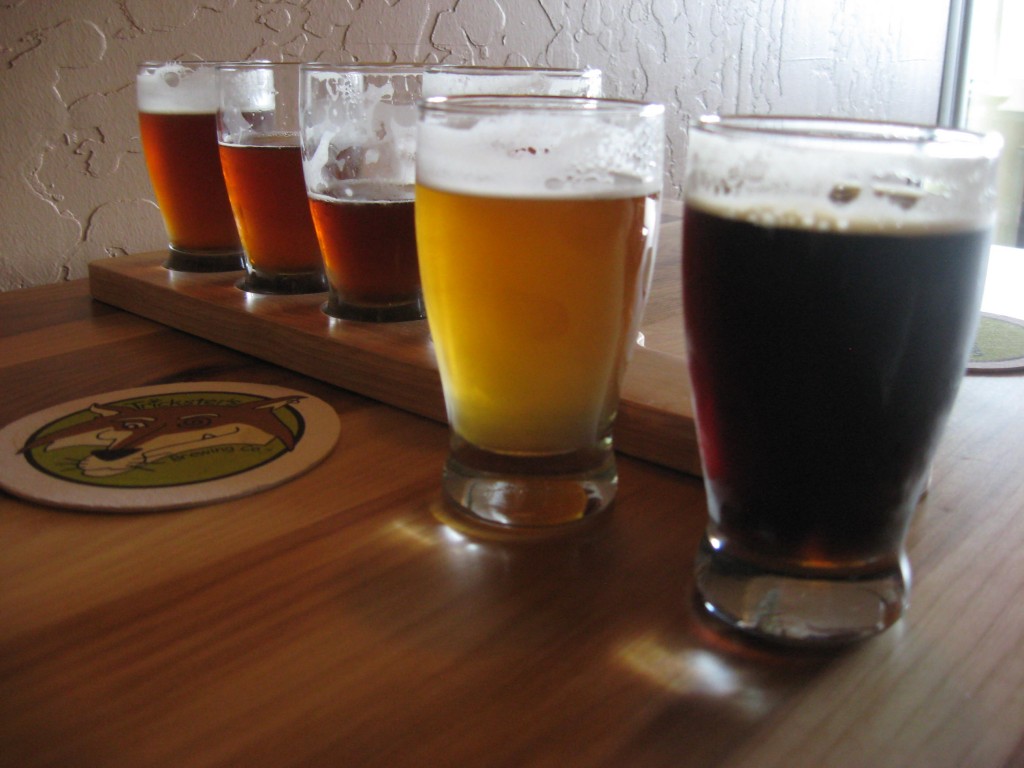
Top Ten Christmas and Holiday Ales

From Beerinfo.com

Great Lakes’ Christmas Ale- The Great Lakes Brewing Company’s Christmas Ale is a repeat World Beer Championship Gold Medal winner. The full-bodied, spirited beer is copper in color and has a combination of cinnamon, fresh ginger, and sweet honey tones. Christmas Ale is crafted from American two-row wheat, roasted barley, and English crystal hops, among other ingredients and is designed to complement most holiday meals.

 Anderson Valley Winter Solstice – From the first sip of Winter Solstice Seasonal Ale , your senses will be aroused with the vision of a glowing fire, warming the hearth and home, as gently drifting snow flakes silently blanket the trees outside. Each lingering sip will gently warm your soul with thoughts of family and friends, gathering around the table for the feast. Luscious, creamy, smooth, and warming, this medium bodied ale is brewed with Caramel and crystal malts to give it just a hint of sweetness, then paired with our private blend of holiday spice. Winter Solstice Ale is great alone or as an accompaniment to any meal, and it has been known to liven and spice up nearly any social event.
 
Pyramid Snow Cap – A rich, full-bodied winter warmer crafted in the British tradition of holiday beers. This deep mahogany colored brew balances complex fruit flavors with a refreshingly smooth texture, making Snow Cap a highly drinkable and desirable cold weather companion.

Sweetwater Festive Ale – A full-bodied, high-octane brew capped off with our use of cinnamon and mace. This beer will warm you all the way to your bones. Brewed only one day a year for the holiday season.


Continue reading “Top Ten Christmas and Holiday Ales”

On the Joys of Beerhunting

Written by Tom Becham for Professor Goodales

Courtesy pencilandspoon.com

There is really no definition of the word “beerhunting” (other than a truly lame one on Urban Dictionary).  Nor is there one of “beerhunter”, though renowned beer author Michael Jackson was known by that name.

I choose to define beerhunting as the pursuit of new, different, unique and tasty fermented grain beverages.
Simply ticking names off of a list is hardly the point of beerhunting, and misses a lot of the allure of it for me.  To me, it is about the pursuit of knowledge and hedonistic enjoyment.
This includes seeking and purchasing many different kinds of bottled offerings, to be sure.  But the best and most enjoyable feature of beerhunting, is going to brewery tasting rooms and brewpubs.
I have a couple of reasons for feeling this way. First, it is an old aphorism that beer is best when consumed fresh and near the brewery.  Setting aside for a moment the exceptions like bottle-conditioned and deliberately aged offerings, that statement is largely true.

Continue reading “On the Joys of Beerhunting”