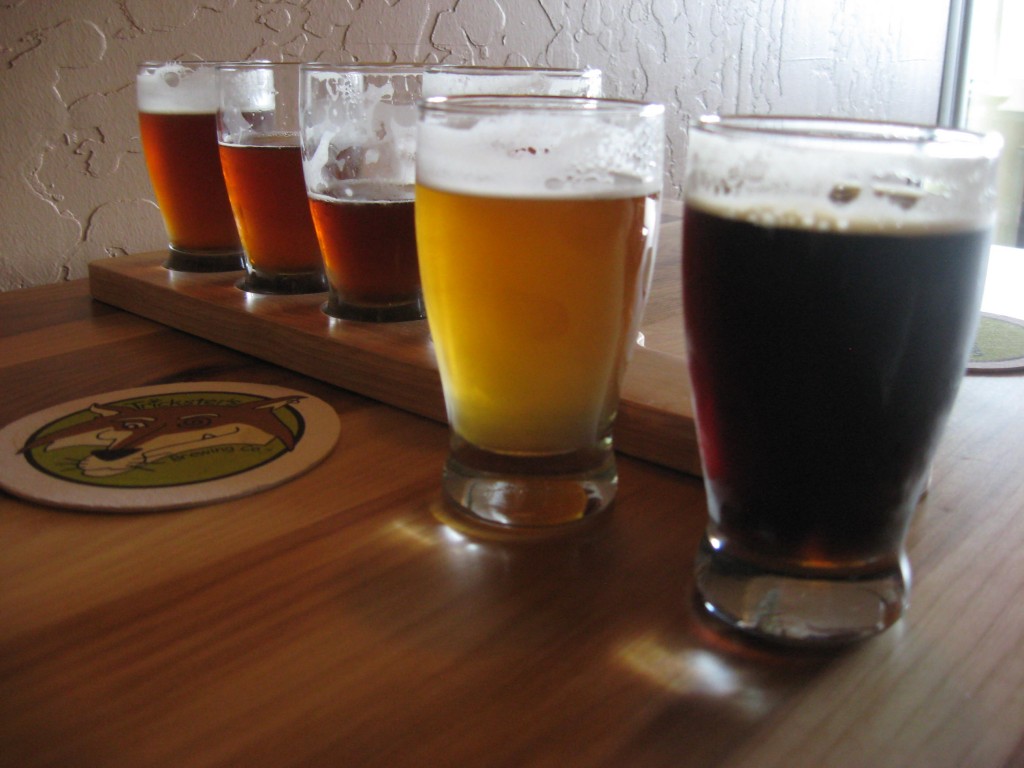

 The color is golden amber, the clarity is exceptional and the head is white, uniform and fell modestly to a cap and ring. The mosaic hop is completely under control on the nose and while it hints at orange and shows you some leafy hop greenness too, you cannot smell orange. There is a barely perceptible fruity ester form yeast that tickles the nose like a hint of something sweet. No scent definitions can be applied. Grass. Bread-y with hops making their mark in the body of the beer. A little orange-y tasting but it’s brief and not too overdone as complimentary hop bitter and dryness from perfect attenuation punctuates the moderate carbonation and malty finish. No diacetyl, no dms. I can say no acetyldehyde because I think the fruity ester I was able to perceive is pear like but not sufficient so as to be able to say. There is just a tiny bit of stickiness from hop resin on the tongue as it finishes.
If you have ever had Sunner Kolsch but not too recently as the last batch I had seemed different from my first few, you would have noticed a resiny and substantially bitter hop presence that is not at all fruity. If we say that terroir has to be admitted in order to use local hops in international styles, then this beer meets the style. If you read the guidelines you will note that the style is subject to a not too loose interpretation in that regard. However, they have called it a “Kolsch” instead of a “Kolsch style” ale or beer. This is despite the appellation designation already granted to the Kolsch.
4.1 out of 5. Congratulations Ithaca on a modern yet traditional Kolsch style beer. Their brewing process had to be meticulous.
My score of 4.1 reflects excellence in all five categories but minus a few points for fast falling spots not streaky clinging on the lace which fell just a bit faster than some and was not at all soapy even though it was uniform. Also it reflects the idea that they met the style just a tad bit outside of the flavor parameters with that cheeky point 1 after the 4 and did so with both panache and control.
4.1

Welcome to the PGA beer rating system: one beer “Don’t bother.” Two: Eh, if someone gives it to you, drink. Three: very good, go ahead and seek it out, but be aware there is at least one problem. Four: seek it out. Five: pretty much “perfecto.”


 And when someone doesn’t sense the same the second biggest (perhaps just as important or more) mistake we make is automatically blaming it all on them for having a different perception.


 For all the promo on the can this is NOT a double taste abv mouthfeel wise, or hop-wise. It IS a well balanced IPA with a very interesting hopping, if you accept the caramel. There is some significant caramel malt-like sense in this. I like it, but not the point. The body is low side medium, but the malt makes it seem higher. Carbonation is medium. The caramel malt sense on this heads out of style, really, as it warms.
 gotten harder, the style guidelines more complex. Somewhere I have one of the Guidelines from the 90s. It’s a short pamphlet less than half the width and less than half the depth of the current one, the categories quite simple in comparison, the descriptions the same.
 I headed out to Stone Brewing’s Berlin outpost in Mariendorf with less than great expectations. Stone’s arrival in Berlin had been anything but auspicious. During a press conference in 2014, co-owner Greg Koch presided over the destruction of a pallet of main-stream German beers crushed with a rock dropped from a forklift. The symbolism was lost on no one, and the exercise in cultural tone-deafness did little to endear Stone to the German drinking public beyond the craft beer converts in the crowd.

You must be logged in to post a comment.