“Because getting obliterated and reaching oblivion have a lot in common, or at least the first two letters…”
Ever wonder what some of the more nasty terms related to beerdom are? Just click on the link after the quote to get your answer!
“The ‘victim’ awakens and spends the first few minutes in a daze, trying desperately to remember where they were last night, when they came back, who they came back with and how they managed to take their jeans off and climb into bed the wrong way round without taking their shoes off. The ‘victim’ then becomes aware of the irresistible urge to empty their bowels. This process is known as the…”
Profile by Millie Jenny C. for Professorgoodales.net
Looking for something different for Thanksgiving? Often people will choose heavy, dark, beers to go with heavy and strong flavors like gravy, dressing, turkey, cranberry: one of my favorites.
Hopportunity Knocks may be just different enough, yet strong enough, to balance out the dark meat and the saged dressing, another favorite of mine.
Hopportunity knocks starts with a Cascade nose from fresh hops and other varietal, West Coast hops. Clarity is excellent with a nice creamy head. That head fades fairly quickly, but a slight edge of foam does hang on.
The fresh hop is excellent when it comes to the taste.
Mouthfeel is medium light when it comes to the body with slight carmelization.
Hopportunity has a nice hoppy bite that tickles the nose and then rolls over your tongue with layers of hop complexity. Persists far into the aftertaste.
Overall it is an excellent, complex, hoppy ale. Definitely answer if, when in the store, this Hopportunity knocks.
Brewed by Caldera Brewing, Ashland, Oregon. Their site says brewed with mostly Centennial from the Northwest and 6.8%. Does not mention fresh hops: either way.
A BJCP/AHA homebrew competition, here? Why: yes!!! And: why not?
The Topic: Small Competitions and the Best of Mississippi
Written by Ken Carman for Professorgoodales.net
Ken Carman is a BJCP judge; homebrewer since 1979, club member at Escambia Bay and Music City Homebrewers, who has been interviewing professional brewers all over the east coast for over 10 years.
History was made.
Yes, there have been competitions, but the first officially sanctioned: BJCP and AHA competition in Mississippi was held November 19th, 2011 in Brandon, Mississippi: a suburb of Jackson. A competition in a state where homebrewing is still illegal. In fact I think Ole Miss. is one of the last states, if not the last.
ERG!
Usually I just do a more news reporter-like competition story for The Professor when I cover my judging adventures, and save Brew Biz for reviews of brew businesses, interviews with important brewers  and other facets of the biz. But I feel this column covers two important topics in beer world.
1. That history was made: Mississippi has taken another important step in not just legitimizing homebrew with their first sanctioned competition, but blazing a path that hopefully will be taken many, many more times.
2. Most sanctioned competitions I have judged at are blow out affairs with hundreds to close to a thousand entries, over 6,000 bottles at one. (3 bottles were required.) This was a very small competition with just two categories and a small stipend was offered to judges who traveled to the competition… and as those of who judge often know: judges frequently travel many miles at their own expense. But I would never decide against judging at a competition because it is small. In fact I find small competitions are like small towns and small churches: more intimate, more focused on the reasons why people gather together. Less on the pub crawl, less on competing with other big towns, or the huge coffee hour after the church service.
Big, more often than not, is not better: it’s worse.
That doesn’t mean I’ll stop judging at competitions like Bluebonnet where they had close to 6,000 bottles. It does mean, as a boy who lived near New York City when I was real young, but also a boy who loved it when he moved and started going to a K-12 school with only 500 students, I think I instinctively knew that small competitions like this would have as much, or more, to offer than brew-extravaganzas.
Not unlike the difference between being just one bottle of Bud amongst many on a mega-brewer’s bottling line or all the bottles in one special one off batch. A judge in a small competition might feel like one very special brew amongst a very small number of one off batches for an up and coming nano-brewery.
A lot more care and consideration is give when you’re not one of many.
But the object of my reverie awaits. Let’s move on to the main event: the first sanctioned homebrew competition held near Jackson, Mississippi: Brandon, actually.
Brad Lovejoy, "Welcome to our home!"
Competition Organizer Brad Lovejoy: yeah, that’s him, was a gracious host and a grand organizer. We spent a lot of time on the web planning; E-mailing back and forth, about how judging was to be handled in this small, two category, competition. We had 4 judges: split into two teams of two for American Pale: category 10: then a mini Best of Show (BOS), and three judges for Stouts: 13. They had breakfast both days and we stayed up stairs for the night. Wow! I’m not used to this much attention since I’m usually one judge amongst many.
See what I mean about big is not always better?
J.L. Thompson: yes, that’s his full name, folks, both judged and talked to the judges, and the stewards, before we started. He did a great job and had asked me to chime in with any advice. Except for a few minor things I didn’t have to say anything. I thought from the start J.L. had it handled, and handle it well he did.
Those of us who live in or near large urban centers are used to being able to purchase a fairly wide variety of craft beer.
Sure, regional or international choices can be subject to some limitations, depending upon your locale. But when you can find things like corked 750 milliliter bottles of Chimay in your local supermarket, you know that craft beer has “arrived.”
The clarity was OK, though a tad hazy. Might be chill haze. Head decent. Color: light pale yellow… almost Bud like. No legs.
Nose sweet fruity, abbey yeast, a bit sweet, yeast dominant, pilsner malt-sense way in background.
Abbey yeast dominant in taste. Way too dominant. I understand having it way up front it defines the concept of an Abbey ale in America; though ironically not so much in Belgium; home to most Abbey ales. But this is so dominant it created an almost brassy cloy to the top of the mouth, nice alcohol/abv punch that’s there but not as abrasive or cloying as yeast. Here the brewer did a real good job. But there needs to be more here than what there is. This sub style tends to be a bit simplistic, but not so much as Sprecher’s take on it.
Mouth feel abbey yeast, light pils in the backgroud. Not much else.
Not impressive. A tad lighter than normal Tripel (or “Triple” as they insist on calling it) that needs tad more body and white candi for sense/taste. Overall this goes to balance. The Abbey-White Labs 530-like yeast sense is so dominant it’s hard to taste much else. The problem here is that abbey yeast has become a bit of a cliche’ and this has that taste out the wazoo, and except the slight hint of white candi sugar-like driven alcohol: nada. Needs more complexity, even for style which can be a bit simplistic sometimes. It’s like they decided to brew to the cliche’, but not the sub style.
I was expecting that grassy delightfulness that is a fresh hop ale. What I got was barely IPA, not “fresh hop” in any sense. More like your typical weak IPA with a thin mouthfeel, some malt in the aroma: yes, and taste? …some caramelization; though not all that much. Did they bottle the wrong product into this 22oz?
The clarity was questionable, with a low head that did last: pure pillow. No legs noticed. Light yellow.
Aroma light body/malt, hops faint citrus. Not much more.
Mouthfeel: carbonation right. Malt. Hop firm but not dominaint. The hop mix here, what there is, to be honest is not all that pleasant. As it warms gets brassy and a tad astringent. “Tad” of a “tad” from the start.
The label reads… triple hopped? They’re, right? Light body, though some caramel sense. Hops, what there were, were tad… spicy? Even if you were to buy this as an IPA you might be disappointed, wishing you’d bought Anchor’s Liberty instead.
I think 10 years ago this might have been more interested, but these days any decent hop head might fall asleep drinking this. Now I admit I came home to this after drinking. Boscos’ Hop Harvest: small brewpub chain in Tennesse and Arkansas. Now that was a true harvest ale.
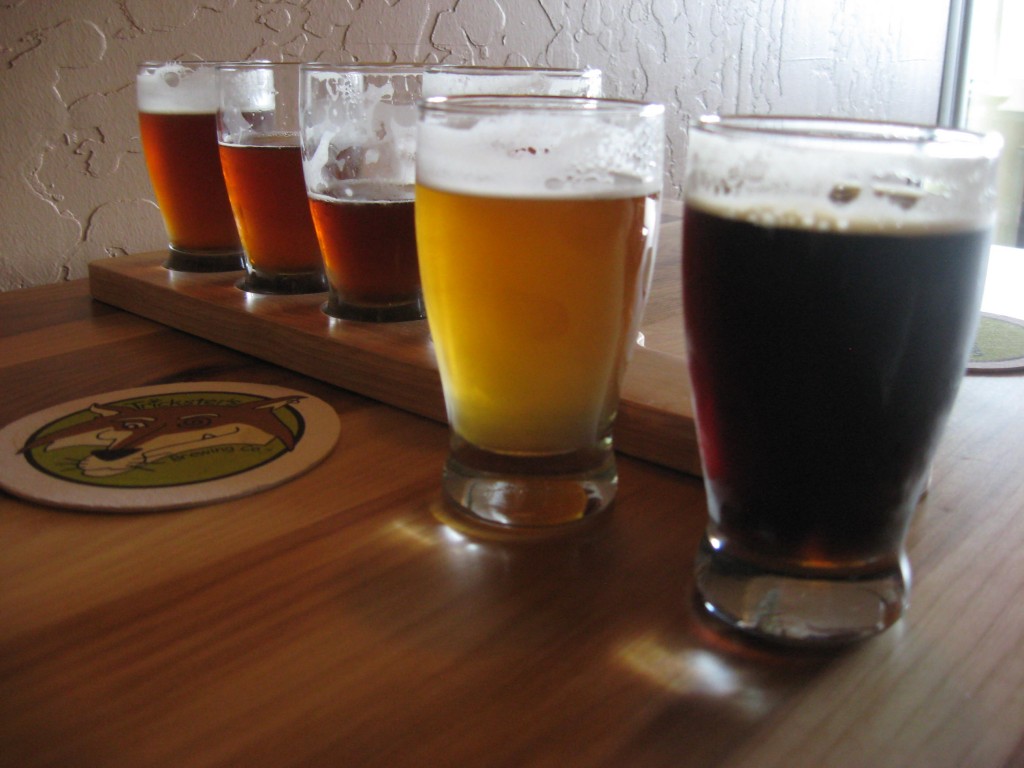
 Looking for something different for Thanksgiving? Often people will choose heavy, dark, beers to go with heavy and strong flavors like gravy, dressing, turkey, cranberry: one of my favorites.


 Not impressive. A tad lighter than normal Tripel (or “Triple” as they insist on calling it) that needs tad more body and white candi for sense/taste. Overall this goes to balance. The Abbey-White Labs 530-like yeast sense is so dominant it’s hard to taste much else. The problem here is that abbey yeast has become a bit of a cliche’ and this has that taste out the wazoo, and except the slight hint of white candi sugar-like driven alcohol: nada. Needs more complexity, even for style which can be a bit simplistic sometimes. It’s like they decided to brew to the cliche’, but not the sub style.
 I was expecting that grassy delightfulness that is a fresh hop ale. What I got was barely IPA, not “fresh hop” in any sense. More like your typical weak IPA with a thin mouthfeel, some malt in the aroma: yes, and taste? …some caramelization; though not all that much. Did they bottle the wrong product into this 22oz?
 The label reads… triple hopped? They’re, right? Light body, though some caramel sense. Hops, what there were, were tad… spicy? Even if you were to buy this as an IPA you might be disappointed, wishing you’d bought Anchor’s Liberty instead.

You must be logged in to post a comment.