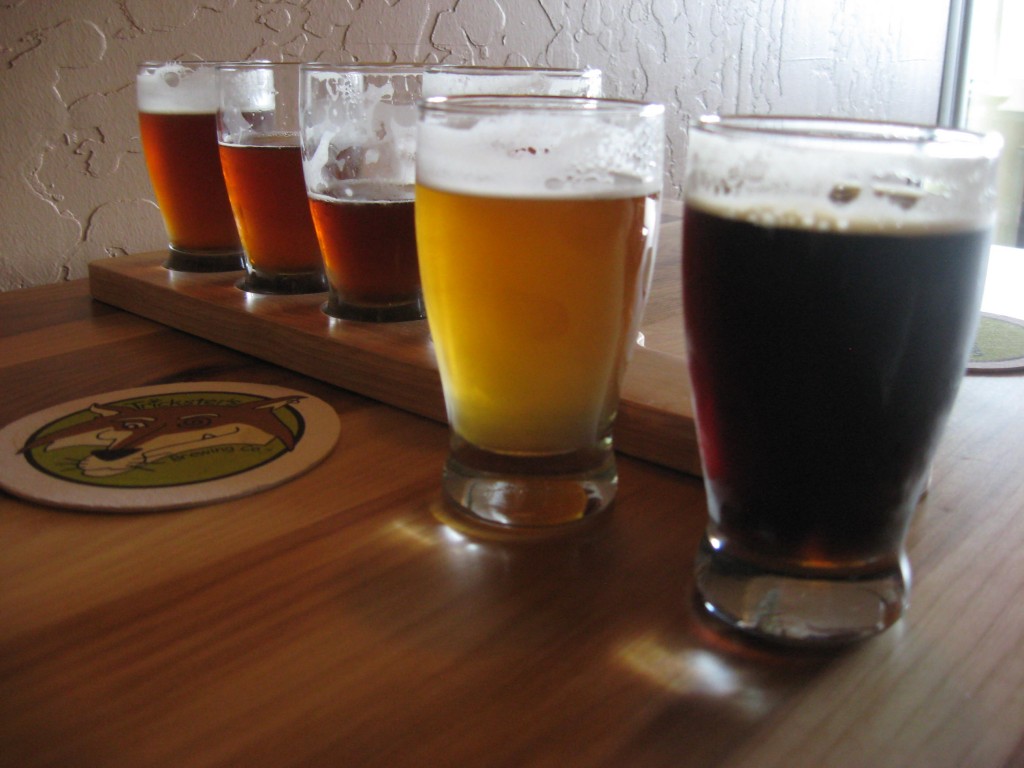
BOSTON (TheStreet) — Craft brewers who makePicture courtesy hedonistbeerjive.blogspot.com low-alcohol beer and put their beer in cans seem to be ignoring history. In reality, they’re learning from it.
The trend toward low-alcohol “session beers” and cans instead of bottles can be a little troubling for anyone old enough to remember the direction American beer took in the late 1970s and early 1980s. When Pabst relaunched the Schlitz brand in 2008 and 2009, Schlitz senior brand manager Kyle Wortham lamented that the beer being sold under the brand’s name before the relaunch had suffered the same “death by 1,000 cuts” that had stripped Schlitz and brands such as Narragansett, Lone Star and others of their original flavor. Continue reading “Cans? Low Buzz? What’s Up With Craft Beer?”
Coincidentally, before I posted that item about Governor Scott Walker’s role in rigging the beer market, I happened to have picked up a six-pack of Pangaea Lillja Argosy IPA.
It was a good  India Pale Ale, perhaps my favorite style of ale. Best of all it cost a mere $6.50, a good price these days.
If Walker gets his way, such small breweries will have a tough time making a go of it. Bottling and packaging costs about four times as much as the actual brewing process and it’s hard for a small brewer to make a profit if he can’t control his distribution.
I’ve interviewed many a microbrewer over the years and all complain that the toughest part of the job is getting wholesalers to push their product.
Hidden Valley is a beautiful, serene setting that rests behind Watkins Glen State Park. There will be an indoor courtyard tasting area with music and specialty food and an outdoor courtyard area also with tasting and live music. Event is held rain or shine.
Some overnight group cabin rentals, sleeping 10-20, will be available for $120, email for details.
In the battle between international brewing giants SABMiller and ABInBev, Wisconsin craft brewers could bear the heaviest burden. On May 31, the state legislature’s Joint Finance Committee approved a measure to be added to the state’s budget proposal which would prevent brewers from owning distributorships and retail licenses in Wisconsin. This means that if you’re a brewer, you can’t also sell alcoholic beverages to customers or retail shops.
The biggest backer of the bill is SABMiller, or as it is known in the US, MillerCoors. They have been pushing the measure, they say, in order to protect the vitality of Wisconsin beer in the face of a hostile invasion from their main national competitor, AB InBev, aka Anheuser-Busch. InBev has reportedly begun a nationwide campaign to purchase distributors in many states, something that MillerCoors says threatens all other brewers’ ability to get their beers in bars and on shelves. That’s the line that MillerCoors is peddling, but craft brewers in Wisconsin say they, and their ever increasing presence in the beer market, is the true target of the proposal.
While the text of the measure has not been made available to the public yet, the proposal would reportedly remove brewers’ current right to own wholesaler and retail licenses. Brewers of less than 300,000 barrels annually will still be able to self-distribute, but current brewers and new wholesalers would be required to have 25 independent retail customers prior to being granted the right to distribute. According to a MillerCoors spokesperson, these new rules would also prevent small brewers from banding together to form their own distributorship. In addition to all of that, the measure would prevent brewers from owning retail licenses, meaning that they could have a brewpub, but they would only be allowed to sell their own product. Breweries that already own retailing outlets would be allowed to retain one.
Courtesy prweb.comIt’s no secret that the Finger Lakes is home to over 100 wineries, but few people realize it’s also home to a number of craft beer brewers as well. With over a dozen microbreweries in the region, plus another dozen or so brew pubs and tap houses, we have the makings of a beer trail — the Finger Lakes Beer Trail that is. Local beer-enthusiasts, Adam Smith and Theresa Hollister, recognized the need for increased awareness and promotion of the region’s growing beer culture, so in February they co-founded Finger Lakes Beer Trail Marketing & Tourism Associates.
While Smith and Hollister modeled the concept of the Finger Lakes Beer Trail after the wine trails of Seneca, Cayuga, Keuka, and Canandaigua, the beer trail is not limited to just the outlines of the lakes. They have mapped out an area that spans roughly 135 miles across the central part of New York state, stretching east-west from I-390 to I-81 and north/south from I-90 to I-86 / NY 17, resulting in a trail abundant with natural beauty along which tourists and beer aficionados alike can enjoy a tasty selection ranging from small-batch pub brews to award-winning bottled craft beers. There are also numerous opportunities for brewery tours along the way.
“Our mission is simple,†says Hollister. “Increase the visibility and reputation of the region’s craft brewers and other brewing and beer-related businesses.â€
In doing so, they also hope to attract more beer-loving tourists to the Finger Lakes region, which in turn will help to stimulate the local economy.
Could they make Fat Tire in Alabama?As I write this the Brewery Modernization Act has been placed on the post-redistricting break legislative calendar in Montgomery for the Tuesday before our publication.
Everyone I’ve spoken with in the craft beer industry seems optimistic about its passage. Needless to say — knock on wood, throw some salt over your shoulder, say your prayers, etc. — it will be, and may already have been, a great day for Alabama when it passes! Continue reading “Craft’s Trending Eastward”
Ohioans could buy beer with a whopping 18 percent alcohol content under a provision in the state budget proposed yesterday by Senate Republicans.Boston Brewing, the parent of Sam Adams, makes a beer called Utopias with 27 percent alcohol (price: $150 for a 24-ounce bottle).
After holding the line on alcohol content in beer for 69 years, lawmakers might be poised to increase it for the second time in a decade. The limit was increased in 2002 to 12 percent from 6 percent, where it had been since the end of Prohibition in 1933.
The alcohol boost in 2002 was promoted by a coalition of statewide distributors and microbrewers.
This time, state Sen. Jimmy Stewart, R-Albany, proposed the amendment after talking to the owners of Jackie O’s Brew Pub in Athens.
“They as well as other small breweries would be very excited about making some products on a limited basis with a higher alcohol content,” said Stewart, noting that Athens also features a number of Ohio-brewed beers at its annual Beer Week each July.
Written by Cindy McNatt for the Orange County Register
With the exception of the Peace Brewing Keg hanging from the roof, the back yard of Bradley Daniels home doesn't look much out of the ordinary. Photo by Nick Koon for The Orange County Register
When Brad Daniels told a scientist friend of his that he was going to start brewing beer, the friend replied, “I hate when people say they’re going to do something and then don’t.”
Daniels came from a long line of nonstarters, so with determination and a passion for microbrews, the retired engineer began some serious brewing. And he eventually built the pub to go with it.
You must be logged in to post a comment.