It occurred to me that many of the readers of this website may be “beer newbies”. So, while detailed and arcane explanations of brewing gravities, obscure styles of beer, and labeling from long-gone brews may appeal to those of us well-entrenched in Beer Geekery, some more basic writings may also be appropriate.
So, to begin, just what the hell is beer, anyway?
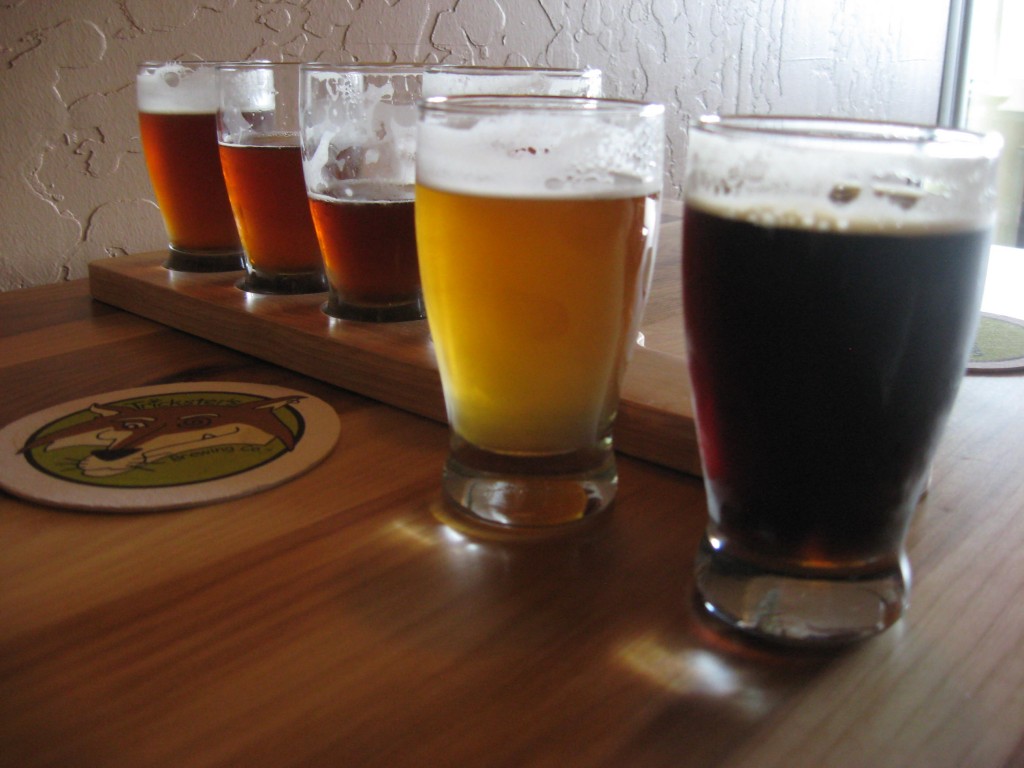
Beer is defined as a fermented grain beverage, usually containing hops. (So, technically, sake is a rice BEER, not a rice WINE.) In the past, to further confuse things, “beer” and “ale” were considered separate things, beer containing hops, ale not containing hops, but some other bittering/preservative agent. Now, however, the umbrella of beer holds under it both lager and ale.
Ken Carman is a BJCP judge; homebrewer since 1979, club member at Escambia Bay, Salt City and Music City Homebrewers, who has been interviewing professional brewers all over the east coast for over 10 years.
  My wife and I have been homebrewing since 1979. To be honest I started with what was probably close to a Russian Imperial, minus the roasted barley since I didn’t know any better, and did variations on that for quite a while. Then we stopped homebrewing for a few years: late 80s and early 90s, because of some physical problems, and returned in the mid-90s. By then homebrewing had gotten real serious with homebrewers owning equipment that would have made George Washington and Tom Jefferson jealous.
Yes, our forefathers were homebrewers.
And it seemed they were all out to brew the most perfect Pale, or IPA. Everything had gotten so tech-y and extract brewing, even with additions, was frowned upon. Of course we obediently followed their lead.
Not.
Just went all grain year before last, but even there we shrunk our brewery rather than trying to brew 10 plus gallons. Now we brew 2 to 2 1/2 gallons and can focus even more on wild and wacky recipes that seem to fit no style. Ciders? Yes, but blueberry, raspberry, and a few apple ciders/cysers. (Yes, I know there’s a difference when talking to the true cyserman, as one of our former club members called themselves.) Continue reading “Brew Biz: Werts and All”
Without intent, I have collected well over 1,000 beer bottles since the early 70s. When something finally had to be done about the cheap paneling in this old modular, I had a choice. Tear down the walls while, oh, so carefully, replacing the often rotted 1X3s. Or: cover them with… The Bottle Collection.
Written by Ken Carman
Wynchwood Brewery
Witney, Oxfordshire, UK
I have mixed opinions about Wynchwood. Some of their beers are marginally impressive, a few “why did they bother?” The last Wynchwood brew hardly seem worth the effort.
To me, Scarecrow is probably one of the best, if not the best, I’ve had from this brewery. Not the hops, which seem mostly not there. The body, the malt, nice, but nothing to rave about. It’s the yeast. The yeast is marvelously bready, almost like a loaf of hardy, wholesome, multi-grain bread from some small, whole food, bakery that only uses natural ingredients. Yet it’s not “dark” or dense, more complex, yet light.
Not rated that high at Beer Advocate: 71, and Rate Beer only a… 23? YIKES!!!
Is it me, or did the reviewers miss the yummy yeast? Personally I think some Americans think yeast should be neutral when it comes to all the flavor components in a beer. Ferment: yes, but otherwise neither be seen or tasted. To me, done well, it’s delicious: if not for how yeast changes beer many Belgian brews would be considered inferior in craft beer world.
This beer used to be called Circle Master, but I never saw that name in the stores here in the states.
Here’s some history and facts… Continue reading “From the Bottle Collection: Scarecrow”
Give me something that is both salty, sweet, hot and cold, and you have given me the perfect food. Yes, I will admit that am one of those people that dips French fries in Frosty’s. I am also someone that generally asks for the hoppiest beer on tap. This hasn’t always been the case. My taste in alcohol started off very sweet (think Mike’s Hard Raspberry Lemonade), transitioned to yellow fizz (oh the days of college and Keystone Light), and eventually became addicted to a variety of craft beer.
Tastebud Basics
The average adult has between 2,000 and 10,000 taste buds that perceive sweet, salty, sour, bitter, and potentially a fifth savory taste called umami. Salty and sour detection is needed to control salt and acid balance. Bitter detection warns of foods containing poisons. Sweet provides a guide to calorie-rich foods. Taste buds in combination with smell discern flavor.
(Boulder, CO) – The American Homebrewers Association (AHA) is pleased to announce that Mississippi Governor Phil Bryant has signed a bill that will effectively legalize homebrewing throughout the state. Mississippi is now the 49th state to permit homebrewing. A Senate version of the bill passed in early February and it was then voted on by the State House of Representatives in March.
“From our founding fathers to our current President, this country has a long and storied tradition of homebrewing,†said Gary Glass, director of the American Homebrewers Association. “We appreciate the support of all of the homebrewers, the dedicated grassroots efforts of Raise Your Pints and the legislators who have worked so diligently to make homebrewing a reality in Mississippi. We are grateful to Senator John Horhn who introduced this bill and to Governor Bryant for his quick action and support.â€
The 21st Amendment predominantly leaves regulation of alcohol to the states. Therefore, even though homebrewing is federally legal, it is still up to individual states to legalize homebrewing in state codes. Prior to today’s announcement, Mississippi and Alabama were the only two states that did not allow homebrewing. The AHA will continue working with homebrewers in Alabama to legalize homebrewing.
The hobby of homebrewing has seen exponential growth in recent years. The AHA estimates that more than 1 million Americans brew beer or make wine at home at least once a year. Mississippi is home to an estimated 2,200 homebrewers who may now enjoy brewing without the restrictions of a state-wide ban.
Barrel aging beer is not a new trend, but if you look around at your local brew pubs and beer shops you will see the expanding varieties of wood and barrel aged brews. Wood adds additional aromas and flavor components such as vanillin, tannins, spice and toast that brewers can use to their advantage. Many craft breweries have barrel programs dealing in wine and liquor barrel aged brews. The barrels they use usually range from 55 to 65 gallons and are sourced from major liquor distilleries, barrel brokers and vineyards from across the country.
For home brewers, brewing with a 55 gallon liquor barrel is not very practical unless you are brewing with a group and everyone dumps in to fill the barrel (which is very fun by the way). Most home brewers are looking for wooden barrels to hold their 5 and 10 gallon batches. Getting your hands on these smaller oak homebrew barrels can open up a whole new world of homebrews.
Craft beers are offered for sale at Sam’s Wines and Spirits in Chicago. Craft beer has about a 6 percent market share in the U.S. beer market, which is dominated by Anheuser-Busch InBev and MillerCoors. Scott Olson/Getty Images
America loves beer.
In the U.S., we drink $200 billion worth of the hops-brewed libation annually. What many Americans might not know is that most domestic beer, 90 percent in fact, is dominated by just two companies: Anheuser-Busch InBev and MillerCoors.
Innovators, however, are challenging that dominance in the form of craft beer breweries. Small “mom and pop”-style breweries — or regional breweries — now account for about 6 percent of domestic beer sales. That may seem like a small number, but it’s been growing every year since the early 1990s, while big brewers’ share is declining.


 Â Â My wife and I have been homebrewing since 1979. To be honest I started with what was probably close to a Russian Imperial, minus the roasted barley since I didn’t know any better, and did variations on that for quite a while. Then we stopped homebrewing for a few years: late 80s and early 90s, because of some physical problems, and returned in the mid-90s. By then homebrewing had gotten real serious with homebrewers owning equipment that would have made George Washington and Tom Jefferson jealous.
  My wife and I have been homebrewing since 1979. To be honest I started with what was probably close to a Russian Imperial, minus the roasted barley since I didn’t know any better, and did variations on that for quite a while. Then we stopped homebrewing for a few years: late 80s and early 90s, because of some physical problems, and returned in the mid-90s. By then homebrewing had gotten real serious with homebrewers owning equipment that would have made George Washington and Tom Jefferson jealous.
 Give me something that is both salty, sweet, hot and cold, and you have given me the perfect food. Yes, I will admit that am one of those people that dips French fries in Frosty’s. I am also someone that generally asks for the hoppiest beer on tap. This hasn’t always been the case. My taste in alcohol started off very sweet (think Mike’s Hard Raspberry Lemonade), transitioned to yellow fizz (oh the days of college and Keystone Light), and eventually became addicted to a variety of craft beer.
 (Boulder, CO) – The American Homebrewers Association (AHA) is pleased to announce that Mississippi Governor Phil Bryant has signed a bill that will effectively legalize homebrewing throughout the state. Mississippi is now the 49th state to permit homebrewing. A Senate version of the bill passed in early February and it was then voted on by the State House of Representatives in March.
 The 21st Amendment predominantly leaves regulation of alcohol to the states. Therefore, even though homebrewing is federally legal, it is still up to individual states to legalize homebrewing in state codes. Prior to today’s announcement, Mississippi and Alabama were the only two states that did not allow homebrewing. The AHA will continue working with homebrewers in Alabama to legalize homebrewing.


You must be logged in to post a comment.