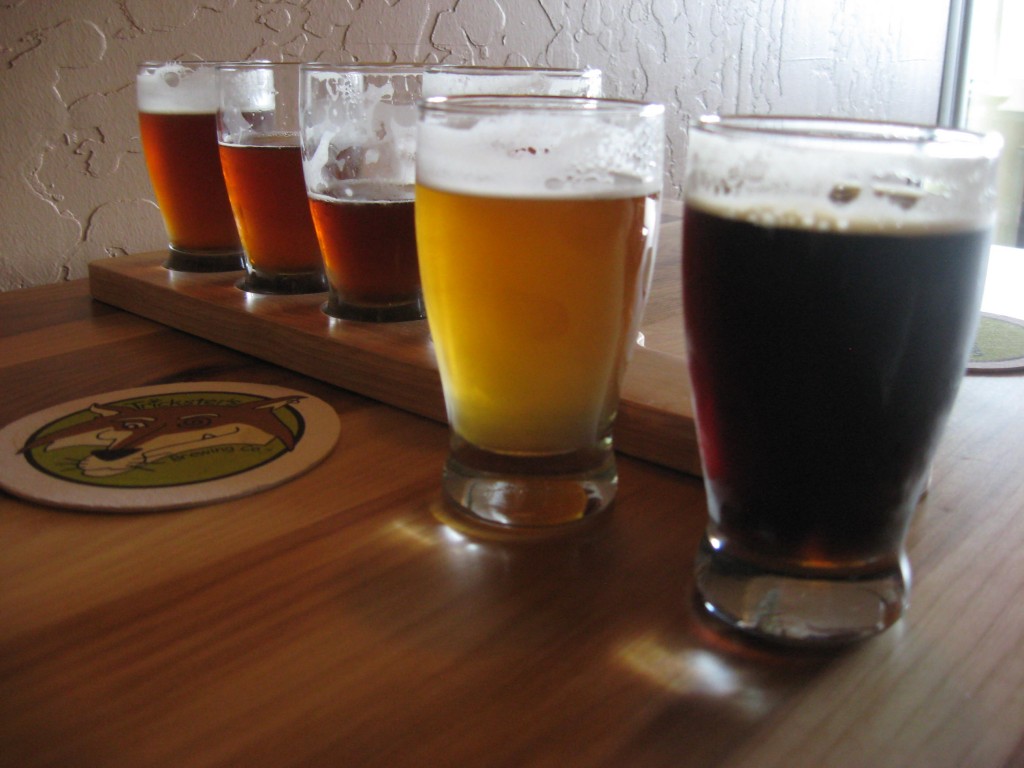
What are the historic success and failure rates of breweries?

We find out the success behind Abnormal Beer company is pretty normal after all.

I quote a close friend: “Craft brewers must have a license to print money.” It was a statement uttered shortly after informing said friend about Cincinnati’s Fifty West Brewing’s $1.5 million expansion, which includes volleyball courts and a cycling business. It seems like every week we announce an exotic expansion or a how-is-that-even-possible success story — from the posh, new pub/restaurant/music venue/brewery that the folks at SLO Brew are building (replete with rentable lofts) to SweetWater Brewing’s announcement that it’s looking for not just one, but TWO new breweries to expand westward.

Sometimes, to the public, it must certainly appear that craft brewers are riding an unstoppable beer train of success (totally different from this snowpiercer), but is that perception a reality?

Want to read more? Please click…

HERE

In New York, Good Times Flow for Craft Brewers

At Rushing Duck Brewing Co., a microbrewery in New York’s Orange County, owners used to pour free samples of beer, because state law prohibited charging customers for a pint at breweries’ tasting rooms.

“We were getting about 200 people per weekend in, and from a keg perspective, that is 2½ full kegs we were going through for free,” said brewery co-owner Nikki Cavanaugh.

But in December 2014, with a new state law taking effect, the brewery began selling pints for the first time. “It increased our revenue drastically,” said Ms. Cavanaugh, 29 years old, who in 2012 founded the brewery about 60 miles north of New York City with her husband, Dan Hitchcock.

Want to read more? Please click…

HERE

New way to make yeast hybrids may inspire new brews, biofuels

Photo: Glass of beer being poured from tap

About 500 years ago, the accidental natural hybridization of Saccharomyces cerevisiae, the yeast responsible for things like ale, wine and bread, and a distant yeast cousin gave rise to lager beer.

Today, cold-brewed lager is the world’s most consumed alcoholic beverage, fueling an industry with annual sales of more than $250 billion.

The first lagers depended on the serendipitous cross of Saccharomyces species as evolutionarily diverse as humans and chickens. The result, however, yielded a product of enormous economic value, demonstrating the latent potential of interspecies yeast hybrids. In nature, the odds of a similar hybridization event are, conservatively, one in a billion.

Want to read more? Please click…

HERE

Trio aims to raise bar with local (Marcy, NY) brew

7140y7v4yji4zttbbs9guyw67d27puxalzstfhgrih49bpt7dbruuejh1mpcmmMARCY,NY — A trio of teachers are just about ready to roll out their first commercial batch of beer at Woodland Hop Farm and Fermentation. The small brewery will begin production Sunday.

Keith Redhead, AJ Spado and Nick Natishak were all teachers at Rome Free Academy and home brewers. Spado, 34, teaches earth science at the school. Natishak, 30, teaches physics there. Redhead, 30, now teaches social studies in Oriskany.

They’d been brewing in their homes for nearly a decade, all while talking about the dream of one day opening a brewery.

Spado and his wife were visiting a small brewery started by a fellow teacher, and Spado asked him if it had been a big leap. The answer — that it was not — empowered Spado to propose the idea of Woodland to his two friends.

Want to read more? Please click…

HERE

Craft Beer, Artisan Spirits, and Boutique Wines: Step Away From The “Bubble”

This may actually be short – and yes, I CAN hear you laughing! – because the whole subject just irritates me so badly that I want to transform my body into electrical impulses, flow through the internet, emerge on the other end, and just slap the shit out of all those people who seem so freakin’ determined to turn this into an Issue.

This business of craft beer and boutique wineries and artisan distilleries suddenly experiencing a bust on the order of the dot-com collapse is pure nonsense, promulgated by people who have little or no knowledge of economics and the average American consumer.

ThreeKindFACT: the dynamic that kept Anheuser-Busch atop the brewing world for generations was the simple act of kids coming of drinking age being raised to think that the precise definition of “beer” was one of a relative handful of adjunct Pilsners, all of which looked and tasted almost identical. If a child grows to his/her majority and sees nothing in their home’s fridge but BudMillerCoorsPabst…

Want to read more? Please click…

HERE

A Brewery Timeline…

The total number of U.S. breweries reached an all-time high in 2015, according to a year-end review from the Brewers Association.

The professional beer industry in the United States has passed a milestone this year with 4,144 breweries, topping the historic high of 4,131 breweries in 1873. Since prohibition, the United States saw its lowest number of brewing companies in 1978, with just 50 brewing companies and 100 brewing facilities.

Want to read more? Please click…

HERE

11 Reasons Why Brewing Beer is the Best Holiday Project

My Thanksgiving weekend didn’t include a turkey, tree, or even a single Mariah Carey song, but it did include an afternoon of brewing beer—which I’d argue is just as holiday appropriate.

Photo by Bobbi Lin

On Sunday, after three days of baking pie, playing cards, and taking long, chilly walks, I coaxed my boyfriend away from a crossword puzzle to brew some beer with me. While it was already a little late to be starting the three-hour process—made even longer by an unexpectedly lengthy boil time, a leaky sanitizing solution, and a bodega-run for more ice—it ended up being one of the best things we did all weekend.

Want to read more? please click…

HERE

A Budget Brewery Built From Shipping Containers

Starbucks has done it. Taco Bell has done it. And now it’s the microbrewery’s turn. The 40ft Brewery in Dalston, London, opened earlier this year. Its name comes from the fact that it was constructed out of two, 20-foot-long shipping containers that sit atop an old car park.

“The spot has a very short rolling lease from the council due to being part of a greater redevelopment plan for the area,” co-founder Andreas Pettersson says. “So by using shipping containers, we can turn this derelict place into a place to brew and serve great beer. If or when we need to move we can pick up our brewery to a new plot of land, we own the brewery and the containers.”

Want to read more? Please click…

HERE